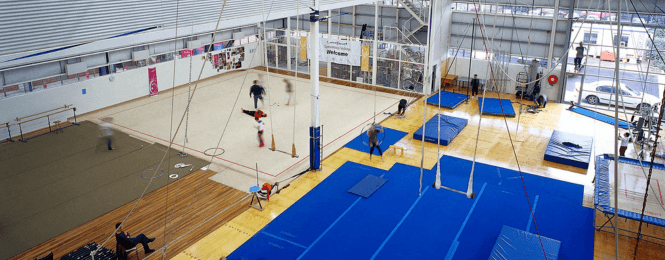
NICA's Sidney Myer Circus Studio by Bates Smart
The first home for tertiary circus education in Australia
In what was once an empty car park lot in Prahran, Melbourne, stands one of Australia’s most unusual and unique educational buildings: the Sidney Myer Circus Studio.
When NICA was established as Australia's national centre for contemporary circus training, NICA’s Director, Pamela Creed, was tasked with creating a permanent home for a new generation of circus artists.
Creed already had a relationship with Bates Smart through another education project and approached the practice with a challenge few architects receive: design a purpose-built circus school. The brief also accommodated Gymnastics Victoria, creating a hybrid facility where circus and gymnastics could coexist and even cross-pollinate within a single structure.
The Sidney Myer Circus Studio was taken on by Bates Smart, and was completed in 2001.
“More than 20 years ago, NICA was blessed with purpose-built facilities funded by both Government and philanthropic support and designed by Bates Smart.
Bates Smart remains one of the oldest and most celebrated architectural firms in Australia. Founded in 1853, by Joseph Reed, their work dates back to so many iconic Victorian buildings including the World Heritage listed Royal Exhibition Building.
With a limited budget, a rare brief, and from a cold start, Bates Smart designed a facility fitting of one of Australia's top 8 Arts organisations. The building is much loved by students and the local community still to today.”
— Ted Baillieu, NICA’s Chair of the Board
Unlike a gymnasium, a warehouse, a classroom or a performing arts centre, the facility needed to support contemporary circus; a discipline that was only just beginning to establish itself as a recognised art form in Australia in the 1990s.
Twenty-five years later, the building remains largely unchanged. Importantly, it is still being used exactly as intended, and is still as significant for Australian circus as it was when it opened.
“As architects, we often measure success by what stands the test of time. For this project, its longevity is one of its greatest achievements” says Bates Smart Director, Jeff Copolov.
The studio is named in recognition of the support of the Sidney Myer Fund, whose early investment helped transform the vision for a national circus school into reality. Former Victorian Premier Sir Rupert Hamer was also instrumental in securing funding and support to start the program.
(read more about NICA’s beginnings here)
Research for the project meant the design team had to look beyond architecture textbooks, and towards modern circuses already developing in Australia. They went on excursions to the Circus Oz warehouse (then in Port Melbourne), all the way to the Flying Fruit Fly Circus in Albury-Wodonga. In these places they formed an understanding of how acrobats trained and what equipment they’d need to use.
While contemporary circus is now a globally recognised art form, with household names like Cirque du Soleil spreading its fame, just three decades ago it was unfamiliar territory.
Luckily the architects were well briefed on how modern circus differentiates from traditional circus, and that they would not be required to accommodate animals or sawdust in a relatively small inner-city lot.
The defining requirement became clear quickly: height.
Circus arts take up space. Aerial disciplines demand clearance, and NICA specified a minimum height of 14 metres. By comparison, a typical commercial storey height is around 3.6 metres, making the Sidney Myer Circus studio almost 4 storeys high.
As a result, Bates Smart created a deceptively simplistic-looking steel box structure, housing an enormous volume. They designed a vast uninterrupted space where aerial apparatus, trampolines, acrobatic equipment and rigging systems could coexist within one flexible space.
“Our response to the brief was a strong muscular building, simple and robust in form, with bold architectural expression” says Bates Smart Director, Jeff Copolov.
Material Choice: Steel
The project's budget was exceptionally tight: approximately $4.2 million to create a state-of-the-art facility. To prioritise the training aspects of the building, Bates Smart embraced radical efficiency. Steel was the answer to both structure and architectural design. Exposed trusses, cross-bracing and external steel are all exposed. The architects describe the approach as "honest" architecture, being a building in which every element is expressed for what it is and what it does.
With such a tight budget, it seemed they needed to do "whatever it took to make the box stand up". But the result was something far more meaningful than imagined. The team even found a way to design artful elements for the building’s facade.
NICA insisted on direct roof access for maintenance and gutter cleaning. Rather than hide the requirement, Bates Smart transformed it into a striking architectural feature. The external fire stairs on the Western end of the building were made bright yellow and shaped into a diagonal cascade, reflecting the energy and action of the acrobats and gymnasts housed inside the building. This engineering expression became one of the building's defining visual qualities.
The Sidney Myer Circus Studio and Gymnastics Victoria complex became a celebration of Australian steel and minimalist innovation. The design picked up several awards, including:
- RAIA (Vic) Chapter Award for Institutional – New, Commendation (2002)
- Property Council of Australia (Vic), Award for Public Buildings, Commendation (2002)
- AISC Victorian Metal Building Award (2002)
- AISC Victorian Premier Steel Construction Award, Commendation (2002)
- AISC Victorian Architect’s Award, Commendation (2002)Arup Award for Outstanding Achievement in Design (National Association of Women in Construction Awards - 2002) Community Facility Design - Sports and Recreation Industry Award 2003.
In the last 25 years, hundreds of artists have trained beneath the studio's steel structure, many going on to perform with leading companies throughout Australia and around the world.
The building has hosted endless training, community programs, graduate productions, professional development, and even Bates Smart's own 2001 Christmas party, where staff celebrated inside the completed studio, while NICA’s students performed circus acts for the architects who had designed their training home.
On NICA’s 25th anniversary, nothing about the building's purpose has changed.
In an era when buildings are frequently adapted, repurposed, or redeveloped, the Sidney Myer Circus Studio stands as a rare example of architecture that has remained relevant for a quarter of a century.
Want to support the maintenance and updating of this beautiful facility?
Consider a donation to our Future Fund
Published 1 July 2026