The Nanjing Project: The Story That Started it All
The most important circus revolution in Australia
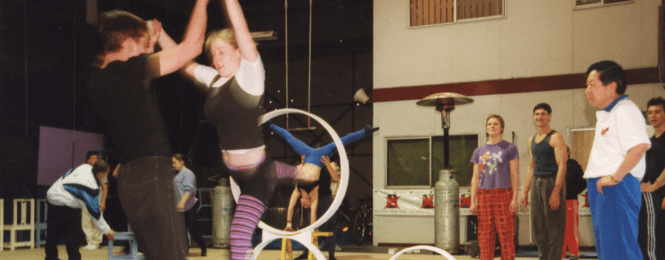
In 1983, in a town better known for football and river gums, Albury-Wodonga was host to a unique cultural exchange. Nestled inside an unassuming community hall, members of the Nanjing Acrobatic Troupe spent 3 months passing on centuries of wisdom to a small group of Australian participants from Circus Oz and the Flying Fruit Fly Circus.
The Nanjing Project would unknowingly create the foundation for the most important circus revolution in Australia.
So how did this relationship between Australian and Chinese circus come to fruition? And why Nanjing?
In 1979, the then-premier of Victoria Rupert Hamer, later Sir Rupert Hamer, signed the very first sister state agreement between an Australian state and a province of the People’s Republic of China. The agreement was designed to promote mutually beneficial trade, education and cultural exchange. In this case, the appointed sisters were Victoria, and Jiangsu – the capital city which is Nanjing.
In the late 1970’s, Carrillo Gantner AC, founder of Playbox Theatre, toured the company extensively through China. Off the back of these tours, and following the sister state agreement, the Chinese Embassy in Australia asked Playbox to organise a national Australian tour of the Nanjing Acrobatic Troupe. In 1980, Playbox Theatre accomplished a 6-week Australian tour for a 50-member international company.
During the tour, following a matinee performance at the Palais Theatre in St. Kilda, Mr Gantner invited members from the newly formed Flying Fruit Fly Circus to come on stage to meet the artists. They had travelled from Albury-Wodonga to see the show, and the kids were starry-eyed at the display they’d just seen.
At that moment, Mr Gantner was struck with the idea to bring the top members of the Nanjing Acrobatic Troupe back to Australia to work with our own circus artists and youth, to see if working with the world’s best would lift their own technical skill level.
It took 3 years to overcome the doubters on both sides, and to organise and fund this complex program.
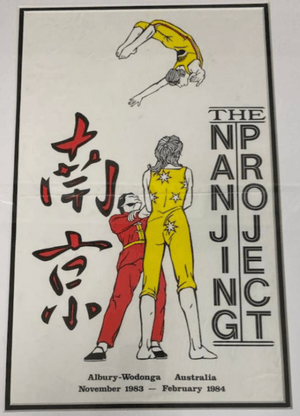

In December 1983, 7 members of the Nanjing Acrobatic Troupe, which included Mr Guang Rong Lu OAM, returned to Australia to begin the 3-month training program in Albury-Wodonga.
For the Australians, the first workshops came as a shock. Until this moment, Australian circus was learned from books, experimentation, word of mouth and sheer love of the game. The Chinese masters demanded something more: repeat, refine, perfect.
Skills like hand balancing, tumbling, human pyramids, pole work and diablo were broken down into drills and repeated until the technique and timing was exact.
The masters shared their philosophies: patience, respect for the process and the understanding that trust between partners is as important as a technical skill. Their approach was structured and disciplined, a far cry from the experimental nature of Australian circus at the time.
For the Chinese troupe, the exchange also offered something new. Having been trained in an environment defined by excellence and precision, the spirited and theatrical nature of Australian circus became a point of intrigue.
At the conclusion of the 3 months, they presented a showing for the community of Albury-Wodonga who had welcomed the artists into their homes and hearts.
They called it “The Great Leap Forward”.
For Australian acrobats, circus and physical theatre artists, it truly was. It was also the major stepping stone on the path to a national circus school.
The impact was immense, and the spark in both cultures was palpable: something special could some of this.
And it did.
Our story of the Nanjing project does not begin and end with one historical exchange program.
What was learned inside a community hall in rural Victoria was no passing moment. The members of Circus Oz returned to stage with their usual humour and storytelling, but this time their performances included a taste of the jaw-dropping physicality of Chinese acrobats.
More than 40 years later, echoes of the Nanjing Project are everywhere, spreading from rural youth circus troupes to city-based education and companies, to global stages.
It's the key chapter that opens the book of Australian Circus and an allegory that reminds us that unassuming pockets of time where art and culture is shared, are often catalyst, to lasting transformation.
_______________
NICA has embarked on a journey to reignite this collaboration between through the Beyond Our Boundaries project, to be completed across June to November 2026.
This project is proudly supported by the National Foundation for Australia-China Relations, which has awarded Beyond Our Boundaries a 2024–2025 grant. Their support makes possible a reciprocal professional exchange between the National Institute of Circus Arts, the Nanjing Acrobatic Troupe and the Shanghai Circus School, building on a legacy of collaboration since the 1980s, and continues to strengthen people-to-people links through cultural exchange.
NICA also gratefully acknowledges the Department of Foreign Affairs and Trade for championing this important collaboration of cultures through circus, helping to sustain and grow Australia–China cultural connections.
Published 4 June 2026